

LogicalApex Offers HIPAA Compliant Analytics With BAA For Healthcare Practices.
Starting at $150/Mon for Healthcare Providers. No Techy Needed. We Setup For You.
If you are a medical, dental or any of these 42 different type of healthcare practices, and you have a practice website, you need analytics that do not transmit PHI to Google analytics or TAG managers according to HHS.
Why healthcare websites cannot use free Google analytics and why use HIPAA compliant analytics?
Healthcare websites cannot use free Google Analytics because Google (and Meta) refuses to sign a Business Associate Agreement (BAA) for the service. Under HIPAA, a signed BAA is legally required whenever a third-party vendor handles Protected Health Information (PHI). Standard analytics tools automatically collect user IP addresses, page URLs, and search terms that link an individual to specific medical conditions or care, which creates severe compliance violations and risks massive fines. Google GA4 Analytics and many of the other tracking apps – Like Tag manager, Meta Pixels are no longer HIPAA compliant.
LogicalApex is a Done-For-You Service. We help practice managers and practice owners every day. So you can focus on patient care. Our pricing is transparent and we provide excellent human customer service, backed by AI agents and 10+ years of healthcare compliance & marketing experience.

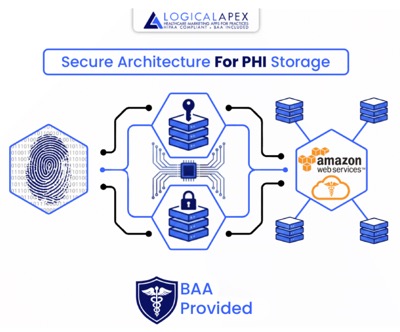
If you are a medical or a dental practice, you are required to use apps and technologies that do not transmit PHI to providers like Meta and Google for tracking purposes. To choose between Server-Side Data Filtering and a HIPAA-Compliant Alternative Platform, you must weigh technical control against legal simplicity.
There are 4 available options for healthcare websites, medical websites, and dental websites:
Overview for Practice Managers
| Approach | Developer Involvement | Who Manages It? | Business Setup | Approximate Cost |
|---|---|---|---|---|
| LogicalApex | None (Done-For-You) | LogicalApex Team | Included (Signs BAA) | $199 – $299/mo |
| Freshpaint | Heavy (Initial setup) | Internal IT / Agency | Included (Signs BAA) | $18k – $25k+/yr |
| Matomo (Cloud) | Low (Basic script install) | Practice Manager / Agency – You are responsible party or your website developer requirements | You are the BAA – as you have to attest to all HIPAA requirements | $30 – $100+/mo |
| DIY (Self-Hosted) | Nightmare (Ongoing dev) | A software engineer | Your Liability | Server costs only |
Option 1: LogicalApex Secure Analytics Platform Starting from $150/mon for single location healthcare practices
Using industry proven secure practices, LogicalApex hosts analytics software and databases securely. LogicalApex hosts its platform and applications on secure, healthcare-grade cloud infrastructure primarily managed through Amazon Web Services (AWS) and Google Cloud Platform configured for HIPAA and HITECH. Access to the dashboards is provided using role-based, secure HipaaServer. Professional human customer support is included.
Core Analytics Features
- Secure Dashboards: Real-time, performance tracking.
- Integrated Tracking: Monitors lead generation, SEO, and advertising metrics safely.
- Role-Based Access: Restricts data views to authorized users only.
- Covered by BAA: Backed by a standard Business Associate Agreement.
- Healthcare practices that have 1 to 100 locations.
- Installation is very simple – most customers go live in 1 week.
- LogicalApex does all the setup.
- No technical knowledge required.
Option 2: Server-Side Data Filtering
This path keeps Google Analytics 4 (GA4) and Google Tag Manager (GTM), but adds a proxy server between your website and Google.
- How it works: Data goes to a server you control (e.g., AWS or Google Cloud with a signed BAA) before hitting Google.
- The Benefit: You keep using familiar Google tools and dashboards.
- The Catch: You must manually strip out IP addresses, user IDs, and URLs containing health conditions.
- The Risk: Human error in filtering configurations can still result in accidental HIPAA violations.
- Coding and technical resources are required. Consultants fees are extra. It takes many weeks to even few months to implement. Large hospitals typically use this.
- Cost is very high. Example: Freshpaint works with Google Analytics rather than replacing it. It acts as a privacy and HIPAA-compliant data governance layer. You replace the native Google tracking code on your site with Freshpaint’s code, which captures user behavior and safely filters out sensitive data before forwarding anonymized event data to Google Analytics.
Option 3: DIY – Installing Apps and Providing Your Own Compliance
Self-hosting your own analytics app to handle compliance comes with clear trade-offs. While it gives you complete data ownership and saves on subscription costs, it transfers the burden of server maintenance and security to you. As a medical clinic, your stakes are incredibly high because you are bound by HIPAA and strict patient privacy regulations.
If your website analytics accidentally capture Protected Health Information (PHI)—such as a patient’s IP address combined with a page view of a specific medical condition or appointment booking confirmation—sending that data to a standard cloud provider without a legal agreement is a severe violation. Self-hosting an analytics tool like Matomo or Umami introduces unique medical-specific advantages and major liabilities.
Pros for a Medical Clinic
- No Business Associate Agreement (BAA) Required: Usually, healthcare providers must get tech vendors to sign a BAA legally promising to protect PHI. When you self-host, there is no third-party vendor. The data never leaves your infrastructure, which removes the risk of a third-party data leak.
- Absolute Perimeter Control: You can place the analytics database entirely behind your clinic’s existing secure firewall. You dictate exactly who has access to the server logs, keeping patient footprints completely locked down.
- Zero Commercial Data Exploitation: Standard analytics scripts (like Google Analytics) allow tech giants to compile digital cross-site profiles of users. By self-hosting, you ensure your patients’ browsing behavior isn’t packaged and sold to advertisers.
- Simpler Legal Documentation: Your privacy policy becomes straightforward. You do not have to list corporate third-party processors or explain how they handle user cookies—you simply state that website performance data is securely managed internal to the clinic.
Cons for a Medical Clinic
- 100% Regulatory Accountability: When you manage the infrastructure, you inherit all compliance liability. If a security vulnerability allows a hacker to access your server or its database logs, your clinic faces direct legal and financial penalties for a data breach.
- Rigorous Security Overhead: In healthcare, “setting and forgetting” a server is dangerous. You must continuously handle server patching, implement daily encrypted backups, monitor for intrusion, and keep strict access logs for auditing.
- No Vendor Tech Support: Open-source, self-hosted software means no helpline to call during an outage or security scare. If the database corrupts or crashes, your internal IT team or contractor is entirely responsible for restoring it.
- Hidden Engineering Costs: While the software license is free, the specialized engineering labor required to properly build and secure a HIPAA-aligned server environment is highly expensive.
The Verdict for Healthcare Providers
If your clinic does not have a dedicated IT administrator or an external managed service provider with deep cybersecurity expertise, do not attempt to DIY self-host. The risk of a server misconfiguration outweighs the benefits. Instead, look into HIPAA-compliant, fully managed cloud analytics that will sign a BAA—such LogicalApex offer this service for starting at $150/mon and provides a BAA.

 Send Text
 How may I help you?